
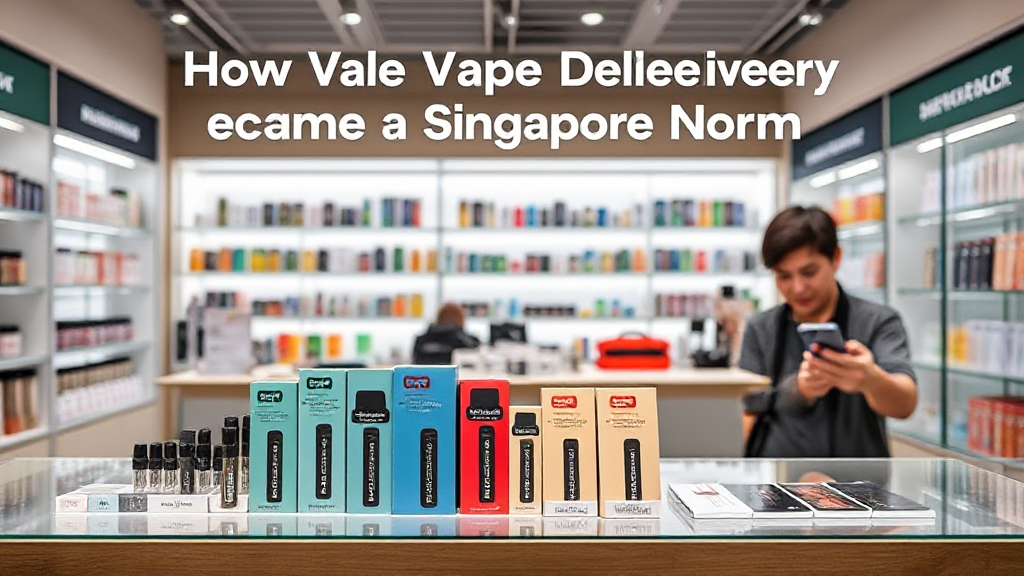
How Lana Vape Delivery Became a Singapore Norm
Buying a vape in Singapore today looks nothing like it did a decade ago, and delivery is the reason. What was once a counter transaction, a quick word with a shopkeeper, a paper bag handed across a counter, has quietly become a doorstep moment. You order from your phone, you wait, and a parcel arrives. For anyone curious about how that shift happened, the story is less about one product than about an entire retail culture changing shape. And if you want to see the current endpoint of that change, the lana vape singapore range available through online shops is a fair place to start, because it sits right at the intersection of product variety and delivery convenience.
From Counter Sales to Couriered Parcels
To understand why delivery became normal, it helps to remember what came before it. In the earlier years of the local vape scene, buying anything meant physically going somewhere. You learned which shops carried which brands, you made the trip, you asked what was in stock, and you often left with whatever was available rather than whatever you actually wanted. Stock was unpredictable, opening hours were fixed, and your options were limited by geography. If you lived far from the shops that carried the products you liked, you simply went without or settled for something else.
That model had obvious friction. It required time, travel and a certain amount of luck. It also meant that product knowledge spread slowly, by word of mouth, from person to person. A new device or flavour could take weeks to become widely known because there was no easy way to browse a full catalogue from home. The idea that you could compare several lines, pick a flavour, and have it arrive the same day would have sounded like a small luxury rather than a baseline expectation.
What changed was not a single invention but a combination of habits. People grew used to ordering everyday items online and expecting fast fulfilment. Messaging apps became the default way to ask a question and get an answer within minutes. Small retailers realised they did not need a busy storefront if they could reach customers directly and deliver reliably. Delivery stopped being a special favour and started being the normal way the category operated.
The Regulatory Backdrop That Shaped Online Retail
No account of vape retail in Singapore is complete without acknowledging the regulatory environment. The rules here are strict, and they have been strict for years. That strictness shaped the market in ways that are easy to overlook. It pushed much of the activity online, it made discretion a practical necessity rather than a marketing gimmick, and it encouraged sellers to be precise about what they offer and how they communicate.
For buyers, this backdrop created a strange mix of caution and convenience. On one hand, people became more careful about where they ordered from and what they expected to receive. On the other, the online format actually suited the situation well: a website or messaging channel can present a clear catalogue, answer questions directly, and arrange a delivery without a public retail presence. Discreet packaging moved from being a nice extra to an expected standard, because customers wanted their orders to arrive quietly and without fuss.
This is also why support channels matter so much in this market. When you cannot walk into a shop and ask in person, the quality of the conversation you have before buying becomes the substitute. Instant messaging support, clear product descriptions and honest stock information effectively replace the shopkeeper’s advice. The vape contact options offered by established online sellers exist precisely because that pre-purchase conversation is now central to the experience.
How Same-Day Delivery Became the Expectation
Same-day delivery did not become standard overnight. It grew out of a simple competitive reality: once one seller could get an order to a customer quickly, everyone else had to keep up. Speed became a differentiator, then a norm, and eventually a baseline that customers simply assumed. Today, a buyer in Singapore who places an order in the morning often expects it to arrive before the day is over, and sellers organise their stock and logistics around that expectation.
Several things had to line up for this to work. Sellers needed ready stock on hand rather than a drop-shipping model that depends on distant warehouses. They needed reliable local courier arrangements. They needed to be reachable at short notice, which is where messaging apps became indispensable. And they needed to manage expectations honestly, because a same-day promise that fails is worse than a slower promise that holds.
The result is a retail culture where vape delivery singapore customers treat timing as part of the product. It is not just about what arrives, but when. This shift has real consequences for how sellers choose their inventory. Slow-moving products are risky because they tie up capital and shelf space, while popular lines are kept in steady supply so that a delivery promise can actually be met. The whole system rewards sellers who understand their own demand patterns.
Where Lana Lines Fit Into the Picture
Within this delivery-driven market, certain product lines became familiar names partly because they were consistently available. The Lana range is a good example of how a product family can become part of the everyday vocabulary of local buyers. Rather than one single device, it covers a spread of formats and capacities, which means it appeals to different kinds of users without requiring them to switch brands.
The Lana Pix 20000 Puffs, for instance, sits at the higher-capacity end, aimed at people who prefer fewer reorders and longer intervals between purchases. The Lana Cheer 15000 Puffs occupies a middle position, balancing capacity against size and cost. The Lana Trend 6000 Puffs speaks to users who want something more compact or who simply prefer to change flavours more often. Together they form a ladder of options rather than a single product, and that variety is exactly what online catalogues are good at presenting.
For a buyer, the practical benefit is choice without travel. You can read about each line, compare capacities, and decide what suits your habits. A lana vape shop that keeps these lines in stock effectively removes the old problem of availability dictating choice. Instead of taking whatever happens to be on a shelf, you pick the specification that matches how you actually use the product, and then you arrange for it to reach you.
What Discreet Packaging and Ready Stock Really Mean
Two phrases come up constantly in this market: discreet packaging and ready stock. They sound like marketing language, but they describe concrete operational choices that affect the customer experience. Discreet packaging means the parcel does not announce its contents to anyone who handles it or sees it delivered. For many buyers, this is not about secrecy for its own sake but about privacy and simplicity. A delivery that draws no attention is a delivery that fits neatly into an ordinary day.
Ready stock is the less visible but arguably more important half of the equation. A seller who holds inventory locally can fulfil orders quickly and consistently. A seller who does not will inevitably disappoint customers when demand spikes or when a popular line runs out. Ready stock is what makes same-day delivery credible rather than aspirational, and it is why the better online sellers invest in warehousing and inventory planning rather than relying on unpredictable supply chains.
Put together, these two practices explain a lot about why the online model took hold. Customers get speed and privacy, sellers get a manageable operation, and the transaction stays simple. It is a system built around the realities of the local market rather than an imported template, and that is part of why it has proven durable.
The Role of Messaging Support in Modern Vape Retail
If delivery is the backbone of online vape retail, messaging support is the nervous system. Before an order is placed, most buyers have at least one question. Is this line in stock? What is the difference between two capacities? How long will delivery take to a particular area? In a physical shop, these questions are answered in seconds across a counter. Online, they are answered through chat, and the speed and clarity of those answers shape whether a purchase happens at all.
This is why instant support has become a genuine selling point rather than a footnote. A responsive channel builds confidence. It reassures the buyer that a real operation stands behind the website, that stock claims are accurate, and that someone will help if something goes wrong. It also reduces the friction of decision-making, because a hesitant buyer can get a straight answer instead of guessing.
Over time, this has changed buyer behaviour. People now expect to be able to ask a question and receive a reply quickly, in the same way they expect a parcel to arrive the same day. The two expectations reinforce each other: fast answers lead to faster orders, and faster orders demand reliable fulfilment. A lana singapore delivery request that begins with a quick chat and ends with a parcel at the door is now a completely ordinary sequence, not a remarkable one.
What This History Means for Buyers Today
Understanding how the market got here is useful because it clarifies what to look for. The features that matter today did not appear by accident. Same-day delivery exists because sellers invested in local stock and courier arrangements. Discreet packaging exists because privacy became a baseline expectation. Instant support exists because the pre-purchase conversation replaced the shop counter. Each of these is a response to a real need, and each is a reasonable thing to evaluate when choosing where to order.
It also helps to be realistic about the trade-offs. Speed depends on stock and logistics, so a seller who promises same-day delivery is also promising to hold inventory and manage it well. Variety depends on catalogue depth, which is why a range like the Lana lines, spanning different capacities and formats, is more useful to buyers than a narrow selection. And support depends on responsiveness, which is why a working chat channel is a better indicator of reliability than a polished homepage.
The broader arc is simple to summarise. Vape retail in Singapore moved from physical counters to online catalogues, from uncertain stock to ready inventory, and from in-person advice to instant messaging. Delivery stopped being a convenience and became the organising principle of the whole category. For a curious buyer, that context is genuinely useful, because it turns a list of features into a set of expectations you can hold a seller to. A singapore lana vape order arriving the same day is not a lucky outcome; it is the product of a retail model that was built, deliberately, around speed, privacy and responsiveness. Knowing that history makes it easier to judge whether any particular shop is actually delivering on the promise the market has come to expect.


Leave a Reply